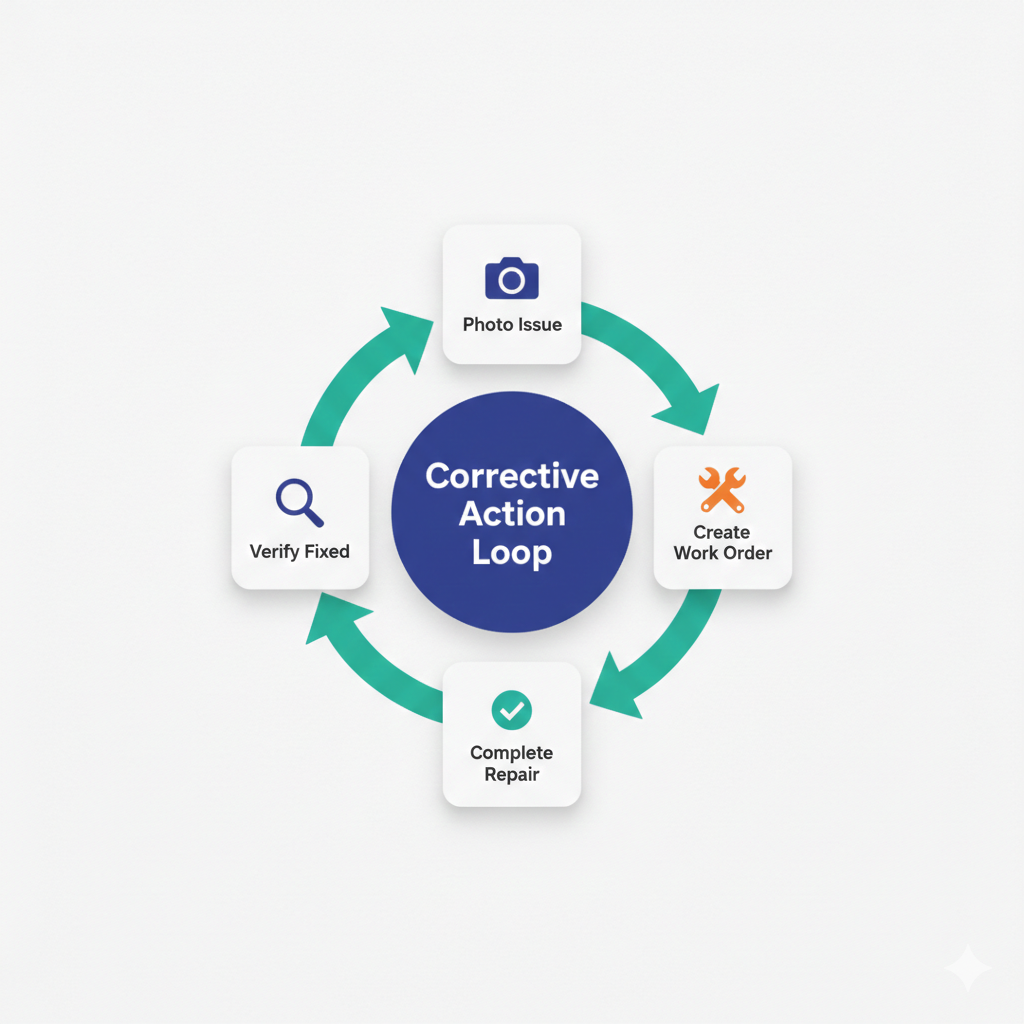

The audit is done. The findings are documented. The action plan is created. Everyone agrees on what needs fixing.
Six months later, the same issues appear on the next audit.
This is the corrective action death spiral—a cycle where hotels continuously identify problems, promise to fix them, partially address them, lose focus, and rediscover the same issues on the next inspection. Industry estimates suggest that 40-60% of audit findings recur within 12 months, representing wasted effort and persistent risk.
Breaking this cycle requires understanding why corrective actions fail and building systems designed for sustained change.
Why Corrective Actions Don’t Stick
Before addressing solutions, understanding failure modes helps avoid repeating them:
The Immediate Fix Fallacy
The most common corrective action failure: fixing the symptom, not the cause.
Example: Audit finding: “Exit sign not illuminated in stairwell B”
- Symptom fix: Replace the bulb
- Root cause analysis: Why wasn’t the burned-out bulb already replaced?
Options include:
- No preventive maintenance schedule for exit signs
- PM exists but wasn’t followed
- Sign replacement parts not in stock
- Staff doesn’t know how to report outages
- Night team didn’t include stairwells in walkthrough
Replacing the bulb closes the finding. But without addressing why the system failed, similar findings will continue appearing throughout the property.
The Documentation vs. Execution Gap
Corrective action plans often look complete on paper:
- Finding identified ✓
- Root cause analyzed ✓
- Action steps documented ✓
- Owner assigned ✓
- Due date set ✓
But documentation doesn’t equal execution. Without verification systems, “plan completed” often means “plan filed.”
The Handoff Problem
Corrective actions assigned during audits often traverse multiple handoffs:
- Auditor identifies and documents
- Manager reviews and accepts
- Department head receives assignment
- Supervisor assigns to staff
- Staff member executes
- Completion reported back through chain
Each handoff introduces delay, distortion, and opportunity for items to disappear. By step five, the original context may be lost.
The Competing Priority Dilemma
Corrective actions compete with daily operations:
- Guest needs feel more urgent than system improvements
- Revenue-generating activities take priority over compliance fixes
- Staffing shortages force triage
- New initiatives push out improvement work
Without explicit prioritization and protected capacity, corrective actions perpetually defer to “after the busy season.”
Pro Tip from the Floor: “We used to assign corrective actions to department heads and consider them ‘in progress.’ Then I started asking for weekly updates. The number of items that stayed ‘in progress’ for months without any actual work was embarrassing. Now we require evidence of activity, not just assignment.” — Director of Operations, convention hotel
The CAPA Framework: Borrowed From Industries That Can’t Afford Repeat Failures
Corrective and Preventive Action (CAPA) systems originated in industries where repeated failures carry catastrophic consequences: pharmaceutical manufacturing, medical devices, aviation. The framework adapts well to hospitality.
CAPA Core Elements
Corrective Action: Addresses the immediate problem and its direct cause Preventive Action: Addresses systemic factors to prevent recurrence Verification: Confirms actions were completed as specified Effectiveness Check: Validates that actions actually solved the problem
Applying CAPA to Hotel Findings
Finding: Guest rooms 401-410 showed inconsistent minibar restocking
Corrective Action:
- Restock all affected rooms immediately
- Retrain assigned room attendant on minibar procedures
- Audit rooms 401-410 daily for two weeks
Preventive Action:
- Update minibar checklist to include count verification
- Add minibar to end-of-shift supervisor spot checks
- Review assignment workload for the affected floor
Verification:
- Training attendance documented
- Updated checklist deployed
- Supervisor spot checks implemented
Effectiveness Check (30 days later):
- Pull minibar discrepancy reports for floors 4 and 5
- Compare to baseline before corrective action
- Confirm reduction in guest complaints and inventory variance
Building Corrective Action Systems That Work
Sustainable corrective action requires process, not just intention:
Phase 1: Capture and Triage
When findings are identified:
Complete Documentation
- Precise description of what was observed
- Location, time, and conditions
- Photo evidence where applicable
- Initial severity assessment
Severity Classification Prioritize based on impact:
| Level | Description | Timeline | Examples |
|---|---|---|---|
| Critical | Guest safety risk, regulatory violation | 24-48 hours | Fire exit blocked, food safety breach |
| High | Brand standard violation, significant guest impact | 3-5 days | Room cleanliness failures, equipment malfunction |
| Medium | Process deviation, minor guest impact | 2 weeks | Inconsistent procedures, training gaps |
| Low | Minor cosmetic, no guest impact | 30 days | Worn signage, minor maintenance items |
Initial Ownership Assign immediately—not to departments, but to named individuals. Unassigned findings become invisible.
Phase 2: Root Cause Analysis
Before jumping to fixes:
Ask “Why” Repeatedly The “5 Whys” technique reveals underlying causes:
Finding: Guest complained about hair in bathroom sink
- Why? Hair wasn’t removed during cleaning
- Why? Room attendant didn’t notice it
- Why? Attendant was rushing
- Why? Workload increased after call-off
- Why? No cross-training allows coverage without overloading
Root cause isn’t the hair—it’s staffing flexibility.
Common Root Cause Categories
- Training: Staff didn’t know the standard
- Resources: Supplies, equipment, or time unavailable
- Process: Procedures unclear, conflicting, or missing
- Oversight: Supervision gaps allowed deviation
- Culture: Standard not valued or enforced
Proportionate Analysis Not every finding requires deep investigation. Match analysis depth to finding severity:
- Critical findings: Formal root cause analysis
- High findings: Abbreviated analysis (3 whys minimum)
- Medium/Low findings: Quick cause identification, pattern tracking
Phase 3: Action Planning
Effective action plans share common characteristics:
SMART Criteria
- Specific: Exactly what will be done
- Measurable: How completion will be verified
- Assignable: Who is responsible
- Realistic: Achievable with available resources
- Time-bound: When it will be complete
Action Types Distinguish between:
- Immediate containment: Stop the bleeding
- Corrective action: Fix what happened
- Preventive action: Stop it from happening again
- Systemic improvement: Address broader issues surfaced
Documentation Standards Each action item should specify:
- Clear description of action
- Named owner (not a department or role)
- Due date
- Required resources
- Evidence of completion expected
- Verification method
Pro Tip from the Floor: “We learned to be very specific in action descriptions. ‘Train housekeeping on new procedure’ became ‘Conduct 45-minute training session for all AM housekeeping staff on minibar verification procedure; training to include role-play and quiz; all attendees to sign training log.’ No ambiguity about what ‘done’ looks like.” — Quality Manager, resort property
Phase 4: Tracking and Visibility
Corrective actions need active management:
Status Categories Move beyond simple “open/closed”:
- Assigned: Action documented, waiting to start
- In Progress: Work actively underway
- Pending Verification: Action complete, awaiting check
- Verified Complete: Completion confirmed
- Closed - Effective: Effectiveness check passed
- Reopened: Issue recurred, additional action needed
Dashboard Visibility Make corrective action status visible to:
- Individual owners (their assignments)
- Department heads (their team’s items)
- GM/Operations (property-wide view)
- Portfolio level (multi-property operators)
Aging Alerts Automatically flag items approaching or exceeding due dates:
- Warning at 75% of timeline elapsed
- Escalation at 100% (due date)
- Executive alert at 125% (overdue)
Regular Reviews Formal review cadence:
- Daily: Critical/high items in operations meetings
- Weekly: All open items reviewed by department heads
- Monthly: GM review of trends and systemic issues
- Quarterly: Portfolio review for multi-property operators
Phase 5: Verification and Closure
Completion claims require proof:
Evidence Requirements Define what demonstrates completion for each action type:
- Training: Signed attendance, quiz results, observation records
- Procedures: Updated document, communication log, adoption confirmation
- Physical fixes: Photo evidence, work order completion, inspection confirmation
- Process changes: New reports running, metrics tracking, system updates
Independent Verification Don’t let action owners verify their own completion:
- Supervisor confirms subordinate’s work
- QA audits corrective action evidence
- Different shift verifies consistency
- Cross-department spot checks
Effectiveness Checks Schedule follow-up to confirm the fix actually worked:
- 30-day check: Has the immediate issue recurred?
- 60-day check: Are leading indicators improving?
- 90-day check: Has systemic root cause been addressed?
Pattern Analysis: The Strategic Layer
Individual corrective actions solve individual problems. Pattern analysis drives systemic improvement.
Tracking Recurring Findings
Maintain a finding database that allows:
- Same finding appearing across properties
- Same finding recurring at same property
- Similar findings in same department
- Correlation with staffing, occupancy, or seasonal patterns
Trend Identification
Regular analysis should surface:
- Which departments generate most findings?
- Which finding types recur most frequently?
- What’s the average time to close different finding types?
- Which properties consistently outperform or underperform?
Root Cause Aggregation
Individual findings may share underlying causes:
- Multiple training-related findings suggest training system gaps
- Multiple resource findings suggest budgeting issues
- Multiple process findings suggest SOP management problems
- Multiple oversight findings suggest supervision capacity constraints
Improvement Prioritization
Use pattern data to prioritize systemic investments:
- High recurrence + high severity = immediate action required
- High recurrence + low severity = efficiency opportunity
- Low recurrence + high severity = risk mitigation priority
- Low recurrence + low severity = monitor but deprioritize
Department-Specific Corrective Action Considerations
Different departments present unique challenges:
Housekeeping
Common Recurring Issues
- Inspection inconsistencies between supervisors
- Training gaps with high turnover
- Time pressure creating shortcuts
- Supply availability affecting quality
Effective Corrective Approaches
- Visual standards (photos, not just descriptions)
- Peer inspection programs
- Real-time supply monitoring
- Workload balancing when call-offs occur
Maintenance/Engineering
Common Recurring Issues
- Preventive maintenance deferred for reactive work
- Knowledge gaps with equipment complexity
- Parts availability causing incomplete repairs
- Documentation gaps for completed work
Effective Corrective Approaches
- Protected PM time windows
- Equipment-specific training certifications
- Par level management for critical parts
- Mobile documentation at point of service
Front Desk/Guest Services
Common Recurring Issues
- Procedure variations between shifts
- Training inconsistency during hiring waves
- Script deviation under pressure
- System usage shortcuts
Effective Corrective Approaches
- Standard work documentation at workstation
- Shadow training with verification
- Call/interaction monitoring programs
- System audits and retraining
Food & Beverage
Common Recurring Issues
- Temperature logging gaps
- Prep procedure variations
- Cleaning schedule adherence
- Allergen communication breakdowns
Effective Corrective Approaches
- Digital temperature monitoring with alerts
- Certified trainer programs
- Opening/closing checklist verification
- Ticket system modifications for allergen visibility
Pro Tip from the Floor: “We noticed our F&B corrective actions had terrible completion rates. The problem? We assigned them to the Executive Chef, who was too busy to track them. When we created a dedicated F&B quality coordinator role—just 10 hours per week—our completion rate went from 60% to 95%.” — Assistant GM, full-service property
Technology Enablers
Modern corrective action management benefits from technology:
Tracking Systems
Effective platforms provide:
- Centralized finding and action documentation
- Workflow automation for assignments and escalation
- Evidence attachment and verification
- Reporting and analytics capabilities
- Mobile accessibility for field verification
Integration Points
Connect corrective actions to:
- Audit and inspection systems (finding source)
- Work order management (maintenance actions)
- Learning management systems (training actions)
- Document management (procedure updates)
- Guest feedback (effectiveness validation)
Alert and Notification Capabilities
Automated communications for:
- New assignments
- Approaching due dates
- Overdue items
- Completion verification requests
- Effectiveness check scheduling
Common Implementation Mistakes
Avoid these corrective action system failures:
Mistake: Creating Too Many Categories
Complex classification systems slow response:
- Too many severity levels (use 3-4, not 7)
- Excessive root cause taxonomies
- Over-detailed action type distinctions
Better: Simple classifications, consistent application.
Mistake: Tracking Only Formal Audits
Limiting corrective actions to periodic inspections misses:
- Guest complaints requiring investigation
- Staff-reported issues
- Near-miss incidents
- Self-audit findings
Better: Single corrective action system for all finding sources.
Mistake: Closing Without Verification
Allowing owners to self-close items:
- Creates perverse incentive to close rather than fix
- No quality check on corrective action adequacy
- Completion rate metrics become meaningless
Better: Independent verification required for closure.
Mistake: No Effectiveness Measurement
Closing items when actions are complete but not evaluating if they worked:
- Same issues recur
- Corrective action appears “done” while problems persist
- No learning about what actually drives improvement
Better: Mandatory effectiveness checks at 30/60/90 days.
Measuring Corrective Action System Performance
Track these metrics to evaluate system effectiveness:
Process Metrics
| Metric | Target | Calculation |
|---|---|---|
| On-Time Completion Rate | > 85% | Actions closed by due date / Total actions |
| Average Days to Close | < 14 days | Sum of closure times / Total closed items |
| Verification Compliance | 100% | Items with verification evidence / Items closed |
| Escalation Rate | < 10% | Items requiring escalation / Total items |
Outcome Metrics
| Metric | Target | Calculation |
|---|---|---|
| Recurrence Rate | < 15% | Findings recurring within 12 months / Total findings |
| Audit Score Improvement | Positive trend | Score change from audit to audit |
| Guest Satisfaction Impact | Positive correlation | Guest scores vs. corrective action focus areas |
| Effectiveness Check Pass Rate | > 80% | Items passing effectiveness check / Items checked |
System Health Indicators
- Backlog size (total open items)
- Aging profile (items by days open)
- Category distribution (finding types)
- Owner distribution (workload balance)
Building Your Corrective Action Improvement Plan
To strengthen your corrective action systems:
Assessment Questions
- What percentage of audit findings recur within a year?
- How many corrective actions are currently open? For how long?
- Who verifies that actions are actually completed?
- When did you last check if past corrective actions were effective?
- What patterns appear in your finding data?
Quick Wins
- Require photo evidence for physical corrections
- Add 30-day effectiveness check to all critical items
- Make overdue items visible in daily operations meetings
- Stop allowing self-verification of completed actions
Systemic Improvements
- Implement formal CAPA methodology
- Deploy tracking technology with dashboards
- Create dedicated time for corrective action management
- Build pattern analysis into quarterly reviews
Ready to break the fix-and-forget cycle? HAS provides integrated corrective action management with finding capture, action tracking, verification workflows, and effectiveness monitoring built for hospitality operations.
Request a demo to see how leading hotels create corrective actions that stick.
Related Reading:

About the Author
Orvia Team
Hotel Audit Experts
The Orvia team brings decades of combined experience in hospitality operations, quality assurance, and technology. We're passionate about helping hotels maintain exceptional standards.