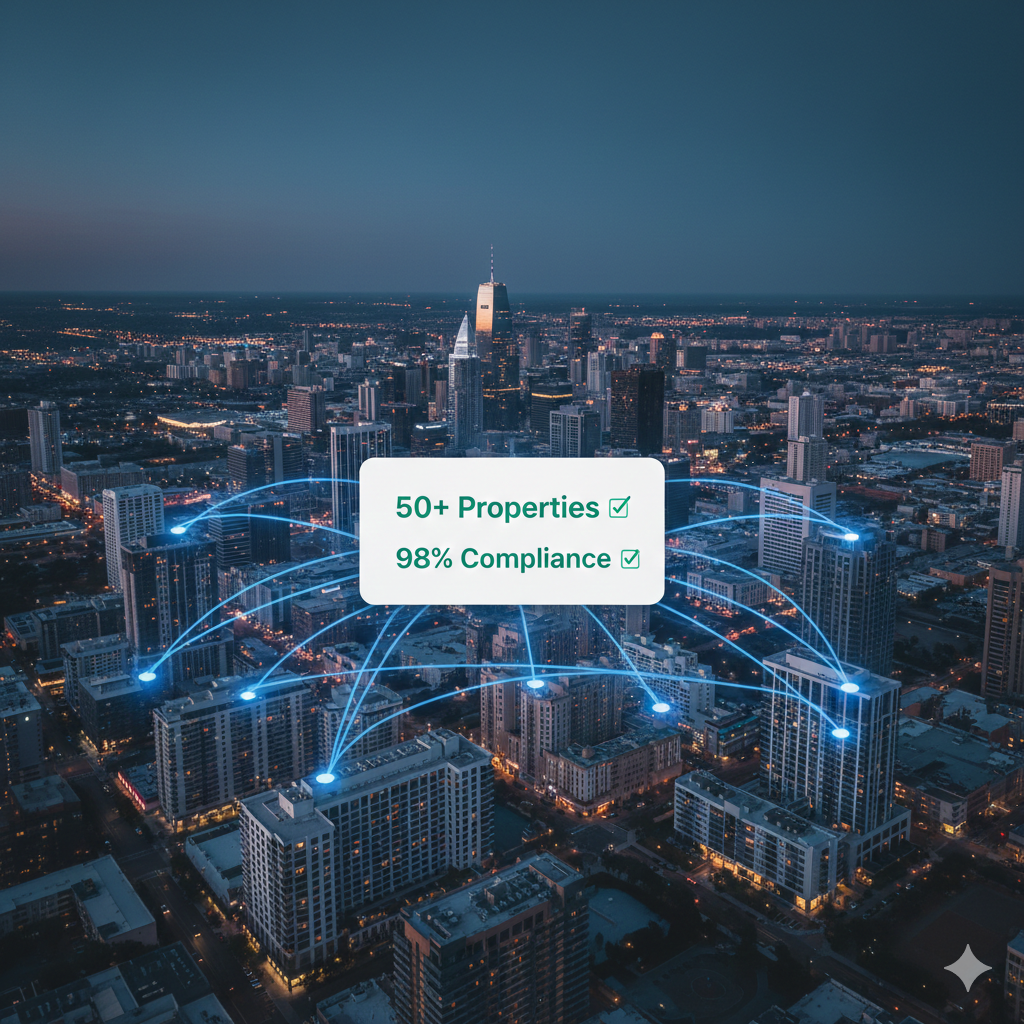

At 5 properties, you can manage audits with spreadsheets and phone calls. At 15 properties, cracks appear. At 50 properties, without a centralized framework, you are managing chaos—inconsistent standards, incomparable data, and no visibility into which properties need attention until something goes wrong.
The shift from single-property thinking to portfolio-level management requires a fundamental restructuring of how audits are designed, executed, analyzed, and acted upon.
This guide provides a framework for building centralized audit management across 50+ properties, covering governance, standardization, technology, and the organizational changes required for success.
The Multi-Property Audit Challenge
What Breaks at Scale
Single-property audit approaches fail at scale for predictable reasons:
| Challenge | Symptom | Root Cause |
|---|---|---|
| Inconsistent standards | Same issue passes at Property A, fails at Property B | No standardized rubric |
| Incomparable data | Cannot benchmark properties against each other | Different checklists, scoring methods |
| Delayed visibility | Corporate learns of issues weeks after occurrence | Manual reporting, no real-time data |
| Resource inefficiency | Regional managers spend 60% of time on data collection | No centralized platform |
| Reactive management | Problems discovered during brand audits, not before | No early warning system |
| Knowledge silos | Best practices at one property do not spread | No sharing mechanism |
The Cost of Decentralization
A 50-property portfolio operating with decentralized audits typically experiences:
- 20-35% variance in audit scores for identical operations
- 4-6 weeks delay between issue occurrence and corporate awareness
- 40+ hours/month per regional manager on data aggregation
- Higher brand audit failure rates due to inconsistent preparation
- Duplicated effort as each property creates its own checklists
Centralization is not about control. It is about efficiency, consistency, and early intervention.
The Five Pillars of Centralized Audit Management
A successful multi-property audit framework rests on five pillars:
- Governance — Who decides, who executes, who reviews
- Standardization — Common templates, scoring, and processes
- Technology — Single platform with multi-property capabilities
- Reporting — Real-time visibility at all levels
- Continuous Improvement — Feedback loops that drive action
Pillar 1: Governance Structure
Roles and Responsibilities
| Role | Scope | Responsibilities |
|---|---|---|
| Corporate Quality Director | Portfolio-wide | Standards development, technology selection, enterprise reporting |
| Regional Quality Manager | 8-15 properties | Standard enforcement, property coaching, regional analysis |
| Property Quality Lead | Single property | Daily execution, staff training, issue escalation |
| Department Supervisors | Department-level | Inspection completion, immediate corrections |
Decision Authority Matrix
| Decision | Property | Regional | Corporate |
|---|---|---|---|
| Daily inspection execution | ✓ | ||
| Checklist item modifications | ✓ | ||
| Local regulatory additions | ✓ | Approval | |
| Corrective action planning | ✓ | Review | |
| Standard changes | ✓ | ||
| Technology selection | ✓ | ||
| Training curriculum | ✓ | Approval | |
| Performance consequences | ✓ | Approval |
Governance Committee
Establish a Quality Governance Committee that meets monthly:
Members:
- Corporate Quality Director (Chair)
- Regional Quality Managers (all)
- 2-3 rotating Property GMs
- IT representative
- Training representative
Agenda:
- Portfolio performance review
- Standard update proposals
- Technology enhancement requests
- Best practice sharing
- Emerging compliance requirements
Pro Tip from the Floor: Include property-level voices in governance. Standards designed without frontline input often fail at execution. Rotating GM participation ensures ground-level reality informs corporate decisions.
Pillar 2: Standardization
Creating the Master Audit Library
Develop a centralized library of audit templates that all properties use:
Template Categories:
| Category | Examples | Update Frequency |
|---|---|---|
| Housekeeping | Room inspection, public area, turndown | Quarterly |
| Food & Beverage | Kitchen HACCP, restaurant, banquet | Quarterly |
| Safety | Fire safety, pool, ADA, emergency | Semi-annual |
| Engineering | Preventive maintenance, room condition | Quarterly |
| Guest Experience | Front desk, concierge, amenities | Quarterly |
| Brand Standards | Lobby, signage, uniforms | Per brand update |
Standardized Scoring Methodology
Inconsistent scoring makes data useless. Establish a universal scoring rubric:
Four-Point Scoring Example:
| Score | Definition | Criteria |
|---|---|---|
| 4 - Exceeds | Notably above standard | Would impress a guest or auditor |
| 3 - Meets | Fully compliant | Meets brand standard |
| 2 - Needs Improvement | Minor issue | Requires correction within 24 hours |
| 1 - Fails | Significant issue | Requires immediate correction |
| N/A | Not applicable | Item does not apply to this property |
Scoring Calibration:
- Conduct quarterly calibration sessions with all regional managers
- Use photo examples of each score level
- Test inter-rater reliability (same situation, same score)
- Document edge cases and ruling decisions
Mandatory vs. Optional Items
Not all audit items carry equal weight:
| Item Type | Treatment | Example |
|---|---|---|
| Critical | Auto-fail if not met | Smoke detector missing, food temperature violation |
| Major | Significant point deduction | Bed not made to standard, bathroom not fully clean |
| Minor | Small point deduction | Dust on lamp shade, amenity slightly misaligned |
| Observation | No points, tracked | Suggestion for improvement |
Localization Within Standardization
Allow controlled customization for legitimate local differences:
Acceptable Localization:
- Local regulatory requirements (fire code variations, health department)
- Property-specific equipment (pool, spa, restaurant type)
- Regional brand variations (resort vs. urban)
Unacceptable Variation:
- Scoring interpretation
- Core cleanliness standards
- Safety requirements
- Guest experience fundamentals
Pillar 3: Technology Platform
Essential Platform Capabilities
A multi-property audit platform must provide:
| Capability | Purpose | Benefit |
|---|---|---|
| Centralized template management | Single source of truth for all checklists | Consistency |
| Role-based access | Property sees own data, regional sees portfolio | Security + relevance |
| Offline functionality | Audits continue without internet | Reliability |
| Photo documentation | Visual evidence attached to findings | Verification |
| Real-time sync | Data visible to all levels immediately | Speed |
| Automated alerts | Notify appropriate people of failures | Early intervention |
| Trend analysis | Identify patterns over time | Proactive management |
| Benchmarking | Compare properties against each other | Accountability |
| API integration | Connect to other systems (PMS, BI) | Workflow |
| Mobile-first design | Works on phones and tablets | Adoption |
Data Architecture Considerations
Hierarchy Structure:
Corporate
├── Region 1
│   ├── Property A
│   │   ├── Department 1
│   │   └── Department 2
│   └── Property B
├── Region 2
│   └── ...
└── Region 3
    └── ...
Data Visibility Rules:
- Property sees only their own data
- Regional sees all properties in their region
- Corporate sees entire portfolio
- Comparative data anonymized at property level (unless explicitly authorized)
Integration Requirements
Connect the audit platform to existing systems:
| System | Integration Purpose | Priority |
|---|---|---|
| Property Management System (PMS) | Room status, occupancy context | High |
| Business Intelligence (BI) | Combined reporting and analysis | High |
| Learning Management System (LMS) | Training triggered by failures | Medium |
| Work Order System | Automatic maintenance requests | High |
| HR System | Performance tracking integration | Medium |
Pro Tip from the Floor: Start with a phased rollout. Pilot with 3-5 properties for 60 days before enterprise deployment. Use the pilot to refine templates, train trainers, and identify integration issues.
Pillar 4: Reporting and Visibility
Report Types by Audience
| Audience | Report Type | Frequency | Content |
|---|---|---|---|
| Property GM | Daily Operations Dashboard | Daily | Today’s inspections, open items, trends |
| Regional Manager | Portfolio Summary | Weekly | Property rankings, red flags, progress |
| Corporate Leadership | Executive Scorecard | Monthly | Portfolio health, risk properties, trends |
| Brand | Compliance Summary | Quarterly | Standard adherence, improvement trajectory |
| Board/Owners | Strategic Overview | Quarterly | Risk assessment, capital needs, benchmarks |
Key Performance Indicators (KPIs)
Property-Level KPIs:
| KPI | Target | Calculation |
|---|---|---|
| Inspection Completion Rate | 95%+ | Completed / Scheduled |
| Average Audit Score | 85%+ | Mean score across all audits |
| Critical Item Pass Rate | 100% | Critical items passed / Total critical |
| Corrective Action Closure Rate | 90% in 48 hours | Closed within SLA / Total open |
| Score Trend | Positive or stable | Month-over-month change |
Portfolio-Level KPIs:
| KPI | Target | Purpose |
|---|---|---|
| Score Standard Deviation | <10 points | Measures consistency |
| Properties Below Threshold | <5% | Identifies at-risk properties |
| Regional Variance | <5 points average | Measures regional consistency |
| Best Practice Adoption Rate | 80%+ | Measures knowledge sharing |
Escalation Triggers
Automate escalation based on data:
| Trigger | Notification | Timeline |
|---|---|---|
| Critical item failure | Property GM + Regional | Immediate |
| Score drops 10+ points | Regional Manager | Same day |
| Score below threshold (3 consecutive weeks) | Regional + Corporate | Weekly report |
| Property in bottom 10% (3 consecutive months) | Corporate + Property GM | Monthly intervention |
| Corrective action overdue 7+ days | Regional Manager | Daily reminder |
Dashboard Design Principles
Effective dashboards for 50+ properties:
- Start with portfolio view — overall health before drilling down
- Use exception-based highlighting — show problems, not everything
- Enable drill-down — click to see underlying data
- Show trends, not just snapshots — direction matters more than position
- Include context — scores relative to targets and peers
- Make it mobile-accessible — executives review on phones
Pillar 5: Continuous Improvement
Feedback Loops
Build mechanisms for improvement information to flow:
| Loop | Flow | Frequency |
|---|---|---|
| Property → Regional | Issues, suggestions, success stories | Weekly call |
| Regional → Corporate | Pattern recognition, resource needs | Monthly report |
| Corporate → Regional | Standard updates, best practices | Quarterly training |
| Regional → Property | Benchmarking insights, coaching | Bi-weekly visit |
Best Practice Identification
Systematically identify and spread what works:
- Identify outliers — properties scoring significantly above average
- Investigate causes — visit, observe, document what they do differently
- Validate transferability — is this replicable at other properties?
- Package for sharing — create training, videos, job aids
- Deploy and measure — roll out to other properties, track adoption
- Iterate — refine based on feedback
Annual Standards Review
Conduct a structured annual review of all audit standards:
Review Questions:
- Are items still relevant to guest experience and compliance?
- Are scoring criteria consistently interpreted?
- Have any items become obsolete?
- What new requirements should be added (regulatory, brand, technology)?
- What feedback has accumulated from frontline staff?
Implementation Roadmap
Phase 1: Foundation (Months 1-3)
| Month | Focus | Deliverables |
|---|---|---|
| 1 | Governance | Role definitions, committee charter, decision matrix |
| 1 | Assessment | Current state audit of existing practices across properties |
| 2 | Standardization | Master audit library draft, scoring rubric |
| 2 | Technology | Platform selection, contract negotiation |
| 3 | Pilot Preparation | Pilot property selection, template configuration |
| 3 | Training Development | Train-the-trainer curriculum |
Phase 2: Pilot (Months 4-5)
| Week | Activity |
|---|---|
| 1-2 | Train pilot properties |
| 3-6 | Execute audits with new system |
| 7-8 | Gather feedback, refine templates |
Phase 3: Rollout (Months 6-9)
| Month | Activity |
|---|---|
| 6 | Wave 1: 15 properties |
| 7 | Wave 2: 15 properties |
| 8 | Wave 3: Remaining properties |
| 9 | Full portfolio live, stabilization |
Phase 4: Optimization (Months 10-12)
| Month | Activity |
|---|---|
| 10 | First quarterly benchmarking |
| 11 | Best practice identification |
| 12 | Annual standards review, Year 2 planning |
Common Implementation Pitfalls
Pitfall 1: Corporate Mandates Without Buy-In
What happens: Properties resist, compliance is superficial, data is unreliable.
Prevention: Involve property-level staff in design. Communicate “why” not just “what.”
Pitfall 2: Over-Engineering Templates
What happens: Audits take too long, adoption drops, shortcuts emerge.
Prevention: Start with essential items only. Add complexity gradually based on need.
Pitfall 3: Technology Before Process
What happens: Platform automates broken processes, problems scale.
Prevention: Define and test processes on paper first. Technology enables, not fixes.
Pitfall 4: Insufficient Training
What happens: Staff do not understand system, data quality suffers.
Prevention: Budget 3x the training time you think you need. Provide ongoing support.
Pitfall 5: No Action on Data
What happens: Beautiful dashboards, no behavior change. Cynicism grows.
Prevention: Commit to acting on findings. Close the loop visibly. Celebrate improvements.
Key Takeaways
- 50+ properties require fundamentally different approaches than single-property management
- Five pillars—governance, standardization, technology, reporting, improvement—must work together
- Standardization enables comparison—without it, data is meaningless
- Technology amplifies process—get the process right first
- Real-time visibility enables intervention—waiting for monthly reports is too slow
- Implementation takes 9-12 months—plan accordingly and pilot before scaling
What to Do Next
- Assess current state — how decentralized are your audits today?
- Identify governance gaps — who makes decisions, who executes?
- Catalog existing templates — how many variations exist?
- Evaluate technology needs — can your current tools scale?
- Build the business case — quantify the cost of current state
For a platform designed for multi-property audit management, schedule a demo →
Related Reading
- Why Audit Scores Vary 20% Across Your Properties
- The True Cost of Paper Audits in 2026
- Audit Failure Recovery: The 90-Day Action Plan
HAS is built for multi-property portfolios with centralized template management, role-based access, real-time dashboards, and benchmarking across your entire portfolio. Manage 5 properties or 500 from a single platform. See how it works →

About the Author
Orvia Team
Hotel Audit Experts
The Orvia team brings decades of combined experience in hospitality operations, quality assurance, and technology. We're passionate about helping hotels maintain exceptional standards.