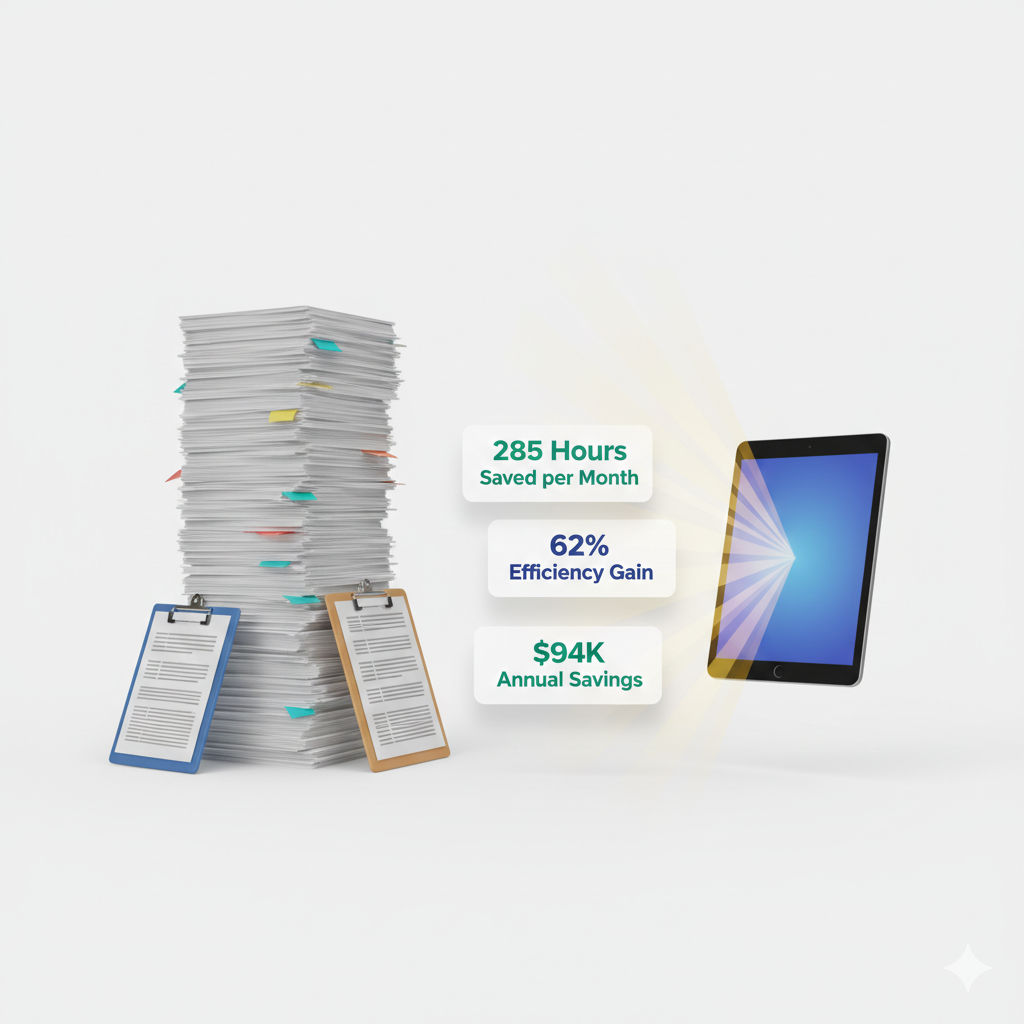

Between January and September 2025, hotels across the United States cut department-level hours per occupied room by 7 to 15 percent across Guest Services, Housekeeping, and Management functions. This was not achieved through layoffs. Properties accomplished these gains through better deployment—making each hour of labor count more, even as those hours became more expensive.
Pro Tip from the Floor: “I used to spend half my day chasing paper checklists and entering data into spreadsheets. Now my morning audit report is waiting when I arrive. That is three hours back every day to actually manage my team.” — Regional Operations Director, 12-property select-service portfolio
The pressure on hotel operators has never been greater. Average wages rose 3.7 to 5.9 percent year over year in 2025, and labor cost per occupied room (CPOR—Cost Per Occupied Room) increased between 2 and 11.2 percent compared to the previous year. Hotels did not grow margins in this environment; they prevented sharper declines by maximizing the value of every labor hour.
This article provides a detailed time-motion analysis of audit processes, quantifies the labor cost savings from automation, and delivers a framework for calculating your property’s specific opportunity.
Understanding Hotel Labor Cost Pressures in 2026
The Current Labor Landscape
The hospitality industry faces a structural labor challenge. Industry data from 2025 reveals:
| Metric | 2024 Baseline | 2025 Actual | Change |
|---|---|---|---|
| Average hourly wage (Housekeeping) | $17.16 | $17.80 | +3.7% |
| Hours per occupied room | Baseline | +2.0% YoY | Increasing |
| Labor CPOR | $6.71 | $7.32 | +9.0% |
| Overtime share (Room Attendants) | 1.49% | 1.67% | +12.0% |
Hotels that embrace operational efficiency can reduce labor costs by up to 15 percent, improve employee satisfaction by eliminating redundant tasks, and deliver higher service levels to guests. The key is not cutting staff—it is improving productivity through smarter systems and automation.
Where Labor Hours Disappear
Before examining automation opportunities, understand where administrative labor hours go in traditional audit operations:
Administrative Time Sinks:
- Manual data entry from paper forms
- Report compilation and formatting
- Chasing down incomplete checklists
- Filing and retrieving historical records
- Transcribing observations into action items
- Email chains coordinating follow-up
- Scheduling and rescheduling inspections
- Photocopying completed audits for archives
Pro Tip from the Floor: “We tracked it for a month. Our GM (General Manager) was spending 4.2 hours per week just on audit administration. That is over 200 hours annually—basically five weeks of a full-time position dedicated to paperwork instead of guests.” — Asset Manager, boutique hotel collection
Time-Motion Analysis: Manual Versus Automated Audits
Methodology
Time-motion analysis measures how long specific tasks take to complete. For audit processes, we break down the complete audit cycle into discrete activities and measure duration for both manual (paper-based) and automated (digital platform) approaches.
Audit Cycle Stages Measured:
- Preparation (scheduling, checklist preparation)
- Execution (conducting the physical inspection)
- Documentation (recording findings)
- Processing (data entry, compilation)
- Reporting (generating summaries, distribution)
- Follow-up (assigning actions, tracking completion)
Standard Room Inspection: Time Comparison
For a standard 30-point room inspection, here is what the time-motion analysis reveals:
| Stage | Manual Process | Automated Process | Time Saved |
|---|---|---|---|
| Preparation | 8 minutes | 1 minute | 7 minutes |
| Execution | 15 minutes | 12 minutes | 3 minutes |
| Documentation | 6 minutes | 0 minutes* | 6 minutes |
| Processing | 12 minutes | 0 minutes | 12 minutes |
| Reporting | 20 minutes | 2 minutes | 18 minutes |
| Follow-up | 15 minutes | 3 minutes | 12 minutes |
| Total per Inspection | 76 minutes | 18 minutes | 58 minutes |
*Documentation occurs simultaneously during execution in automated systems
Key Finding: Automated audits require 76 percent less total time than manual processes. For a 200-room property conducting daily spot checks on 10 rooms, that represents 9.7 hours saved daily.
Monthly Property Audit: Time Comparison
For comprehensive monthly property audits covering 150 checkpoint items:
| Stage | Manual Process | Automated Process | Time Saved |
|---|---|---|---|
| Preparation | 45 minutes | 5 minutes | 40 minutes |
| Execution | 180 minutes (3 hours) | 150 minutes | 30 minutes |
| Documentation | 60 minutes | 0 minutes | 60 minutes |
| Processing | 90 minutes | 0 minutes | 90 minutes |
| Reporting | 120 minutes (2 hours) | 10 minutes | 110 minutes |
| Follow-up | 60 minutes | 15 minutes | 45 minutes |
| Total per Audit | 555 minutes (9.25 hours) | 180 minutes (3 hours) | 6.25 hours |
For properties conducting four major audits monthly (food safety, guest rooms, public areas, back-of-house), that equals 25 hours saved per month—more than three full workdays.
Labor Cost Savings Calculation Framework
Direct Labor Savings
Convert time savings to dollar values using your property’s actual labor costs:
Formula:
Annual Direct Savings = (Hours Saved per Audit × Audits per Year × Hourly Labor Cost)Example Calculation for 150-Room Select-Service Property:
| Audit Type | Frequency | Hours Saved Each | Annual Hours Saved |
|---|---|---|---|
| Daily room inspections | 365 days × 15 rooms | 0.97 hours/day | 354 hours |
| Weekly department audits | 52 weeks × 4 departments | 1.5 hours each | 312 hours |
| Monthly property audits | 12 months | 6.25 hours each | 75 hours |
| Quarterly compliance audits | 4 quarters | 8 hours each | 32 hours |
| Total Annual Hours Saved | 773 hours |
At a fully burdened labor cost of $28 per hour (including benefits, taxes, and overhead):
Annual Direct Labor Savings: $21,644
Pro Tip from the Floor: “The math surprised us. We thought we would save maybe $8,000 annually. When we actually tracked every minute of audit-related work, the real number was closer to $25,000. Most of it was management time we had never properly accounted for.” — Controller, 180-room full-service hotel
Indirect Labor Savings
Beyond direct time savings, automation eliminates several hidden labor costs:
Error Correction Time
Paper-based systems have error rates of 1 to 3 percent for data entry. Each error requires investigation and correction:
| Error Type | Frequency (Paper) | Correction Time | Annual Impact |
|---|---|---|---|
| Illegible handwriting | 2% of entries | 5 minutes each | 40 hours |
| Missing data | 1.5% of forms | 8 minutes each | 48 hours |
| Calculation errors | 0.5% of scores | 15 minutes each | 30 hours |
| Misfiled documents | 3% of audits | 20 minutes to locate | 25 hours |
| Error Correction Total | 143 hours |
At $28/hour fully burdened: $4,004 annual indirect savings
Retrieval and Research Time
When questions arise (insurance claims, brand audits, guest complaints), paper systems require manual searching:
| Research Scenario | Annual Occurrences | Time per Search | Annual Impact |
|---|---|---|---|
| Insurance documentation requests | 6 | 45 minutes | 4.5 hours |
| Brand audit preparation | 2 | 180 minutes (3 hours) | 6 hours |
| Guest complaint investigation | 24 | 30 minutes | 12 hours |
| Regulatory inquiries | 4 | 60 minutes | 4 hours |
| Performance review preparation | 12 | 40 minutes | 8 hours |
| Research Time Total | 34.5 hours |
At $35/hour (management-level labor): $1,208 annual savings
For more on the hidden costs of paper-based systems, see our detailed analysis in The True Cost of Paper Audits in 2026.
Department-Specific Automation Opportunities
Housekeeping Operations
Housekeeping represents the largest labor expense for most hotels. Automation opportunities include:
Shift Scheduling Optimization Forward-thinking properties leverage technology to schedule housekeeping shifts based on occupancy forecasts and real-time room turnover needs. This dynamic approach replaces static scheduling that either understaffs peak periods or overstaffs slow days.
Time Savings from Automated Housekeeping Audits:
| Process | Manual Approach | Automated Approach | Impact |
|---|---|---|---|
| Room assignment distribution | 30 minutes daily | Instant push notification | 30 min/day |
| Completion status tracking | Supervisor rounds (45 min) | Real-time dashboard | 45 min/day |
| Quality inspection routing | Paper list updates | Auto-prioritized queue | 20 min/day |
| Performance documentation | Weekly spreadsheet update | Automatic generation | 60 min/week |
Monthly Housekeeping Admin Savings: 48 hours
For comprehensive housekeeping audit strategies, review our guide: Why Housekeeping Audits Fail (And How to Fix Them).
Food and Beverage Operations
Temperature logging, HACCP (Hazard Analysis Critical Control Points) documentation, and cleanliness inspections consume significant F&B (Food and Beverage) management time:
Traditional F&B Audit Burden:
- Temperature logs: 15 minutes × 4 times daily = 60 minutes
- Pre-shift checklist documentation: 10 minutes × 2 shifts = 20 minutes
- Weekly equipment inspection: 45 minutes
- Monthly health inspection prep: 120 minutes (2 hours)
Automated F&B Audit Burden:
- Temperature logs: Automatic sensor capture = 0 minutes
- Pre-shift checklist: Mobile completion during walkthrough = 5 minutes total
- Weekly equipment inspection: Mobile with photo evidence = 20 minutes
- Monthly health inspection prep: Auto-generated report = 10 minutes
Monthly F&B Admin Savings: 38 hours
Learn more about food safety automation in HACCP for Hotels: Understanding Critical Control Points.
Guest Services and Front Office
While less audit-intensive than operations departments, front office still benefits from automated quality tracking:
| Process | Time Savings Through Automation |
|---|---|
| Lobby condition checks | 5 minutes per shift |
| Guest feedback documentation | 10 minutes daily |
| Shift handoff quality notes | 15 minutes per handoff |
| Front desk supply audits | 20 minutes weekly |
Monthly Front Office Admin Savings: 22 hours
Building the Business Case: Complete ROI Model
Total Annual Savings Summary
Compile all savings categories for a complete picture:
| Category | Annual Savings |
|---|---|
| Direct labor savings (audit execution) | $21,644 |
| Error correction elimination | $4,004 |
| Research and retrieval time | $1,208 |
| Housekeeping admin optimization | $16,128 |
| F&B admin optimization | $12,768 |
| Front office optimization | $7,392 |
| Total Annual Labor Savings | $63,144 |
For a 150-room select-service property, audit automation generates over $63,000 in annual labor savings.
Pro Tip from the Floor: “We presented this business case to ownership expecting pushback. Instead, they asked why we had not automated sooner. When you quantify every hour, the ROI becomes obvious.” — General Manager, independent resort property
Multi-Property Multiplication
For portfolio operators, savings multiply across properties while additional efficiencies emerge at the regional and corporate level:
| Portfolio Size | Property-Level Savings | Regional Savings | Corporate Savings | Total Annual |
|---|---|---|---|---|
| 5 properties | $315,720 | $24,000 | $12,000 | $351,720 |
| 15 properties | $947,160 | $72,000 | $36,000 | $1,055,160 |
| 50 properties | $3,157,200 | $240,000 | $120,000 | $3,517,200 |
Regional and corporate savings come from:
- Eliminated manual report consolidation
- Automated portfolio dashboards
- Reduced travel for audit oversight
- Centralized exception management
For multi-property automation strategies, see Building a Centralized Audit Framework for 50+ Properties.
Implementation Considerations
Phased Rollout Approach
Properties achieving the best labor savings typically follow a phased implementation:
Phase 1: High-Volume Audits (Weeks 1-4)
- Daily room inspections
- Temperature logging
- Shift checklists
Expected Savings Capture: 40% of total
Phase 2: Departmental Audits (Weeks 5-8)
- Weekly department inspections
- Equipment checks
- Safety walkthroughs
Expected Savings Capture: 30% of total
Phase 3: Compliance Audits (Weeks 9-12)
- Monthly property audits
- Quarterly compliance reviews
- Annual certifications
Expected Savings Capture: 20% of total
Phase 4: Optimization (Ongoing)
- Workflow refinement
- Custom template development
- Advanced reporting
Expected Savings Capture: 10% of total
Staff Time Reallocation
The labor hours freed by automation should be strategically reallocated, not simply eliminated:
High-Value Reallocation Options:
- Guest interaction and service recovery
- Proactive maintenance identification
- Staff training and development
- Revenue-generating activities
- Quality improvement initiatives
Pro Tip from the Floor: “We saved 15 hours weekly for our Assistant GM. She now spends that time on revenue calls and VIP (Very Important Person) guest recognition. That is directly tied to a 4-point improvement in our NPS (Net Promoter Score).” — GM, urban lifestyle hotel
Measuring Success: Key Performance Indicators
Labor Efficiency Metrics
Track these KPIs (Key Performance Indicators) to validate labor savings from audit automation:
| KPI | Baseline Measurement | Target Improvement |
|---|---|---|
| Hours per occupied room | Current HPOR | 10-15% reduction |
| Management admin time | % of hours on paperwork | 50% reduction |
| Audit completion rate | % completed on schedule | 95%+ target |
| Error rate | % requiring correction | <1% target |
| Report generation time | Hours to produce reports | 80% reduction |
Financial Metrics
Validate savings through financial tracking:
| Metric | Calculation | Target |
|---|---|---|
| Labor cost per occupied room | Total labor ÷ Occupied rooms | Decrease of $0.15-0.25 |
| Management labor ratio | Mgmt labor ÷ Total revenue | Improve by 0.5-1.0% |
| Overtime percentage | OT hours ÷ Total hours | Decrease by 10-20% |
| Administrative cost ratio | Admin costs ÷ Operating costs | Decrease by 15-25% |
Common Implementation Challenges
Challenge: Staff Resistance to New Technology
Solution: Involve front-line staff in template design and pilot testing. When staff see that automation reduces their busywork rather than monitoring their performance, adoption accelerates.
Challenge: Initial Time Investment for Setup
Solution: Expect 40-60 hours of initial configuration and training. This investment pays back within 60-90 days based on typical savings rates.
Challenge: Integration with Existing Systems
Solution: Prioritize platforms with open APIs (Application Programming Interfaces) and proven integrations with common PMS (Property Management Systems) providers. Data should flow automatically, not through manual export and import.
Challenge: Maintaining Consistency Across Properties
Solution: Establish centralized template governance while allowing property-level customization for local requirements. Corporate standards should be non-negotiable; local additions should be flexible.
For more on overcoming audit technology adoption challenges, review Building a Hotel Audit Culture: Creating Staff Ownership of Quality Standards.
Calculating Your Property’s Opportunity
Use this framework to estimate your specific automation savings:
Step 1: Audit Current State
Document your current audit activities:
- Number of daily inspections: ____
- Number of weekly audits: ____
- Number of monthly audits: ____
- Average time per inspection (minutes): ____
- Average hourly labor cost: $____
Step 2: Apply Time Savings Percentages
Based on time-motion analysis, apply these savings factors:
| Audit Type | Expected Time Reduction |
|---|---|
| Room inspections | 75-80% |
| Shift checklists | 65-70% |
| Department audits | 60-65% |
| Compliance audits | 55-60% |
Step 3: Calculate Annual Savings
Annual Savings = (Current Hours × Reduction %) × Audits per Year × Hourly CostStep 4: Factor in Indirect Savings
Add 15-25% for indirect savings (error correction, retrieval, coordination).
The Bottom Line: Labor Hours Are Your Most Valuable Resource
Every hour your managers spend on audit administration is an hour not spent on guest experience, revenue generation, or staff development. In an environment where labor costs continue rising while skilled workers remain difficult to find, automation is not about replacing people—it is about maximizing the value of every labor hour you pay for.
The properties achieving the best results in 2025 and 2026 are not those cutting headcount. They are properties making each hour of labor count more through technology that eliminates low-value administrative work.
For a 150-room property, the math is clear: $63,000 or more in annual labor savings, recovered within 60-90 days of implementation, compounding across every property in your portfolio.
Pro Tip from the Floor: “We stopped calling it ‘automation’ internally. We call it ‘manager liberation.’ Every hour we give back to our managers is an hour they invest in our guests and our team. The labor savings are real, but the culture impact is bigger.” — VP Operations, regional hotel group
Take the Next Step
Ready to quantify the labor cost savings opportunity for your properties? Request a demo to see how audit automation can transform your operations efficiency and recover thousands of hours annually.
Request Your Personalized Demo →
Our team will help you map your current audit processes, calculate your specific savings opportunity, and develop an implementation roadmap tailored to your operations.
Related Reading

About the Author
Orvia Team
Hotel Audit Experts
The Orvia team brings decades of combined experience in hospitality operations, quality assurance, and technology. We're passionate about helping hotels maintain exceptional standards.