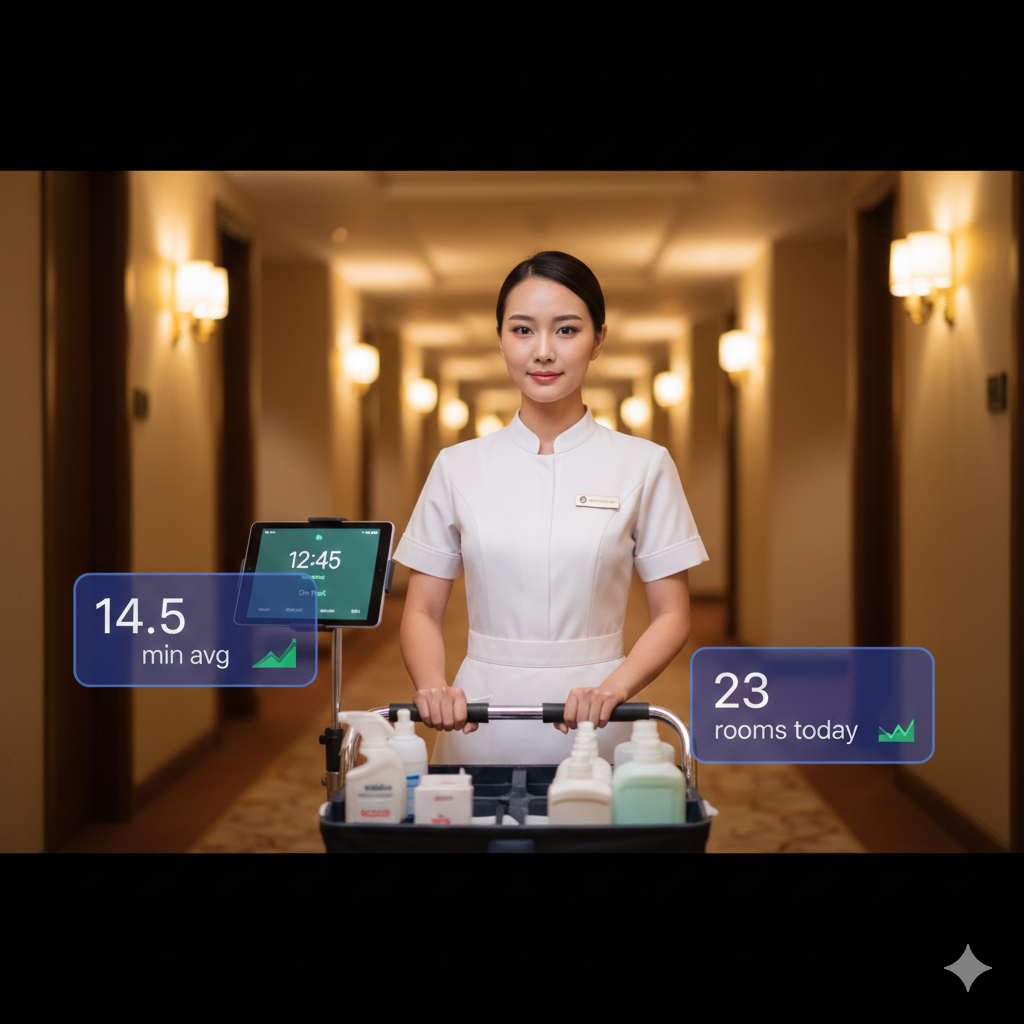

Housekeeping represents the largest labor expense for most hotels. Between January and September 2025, housekeeping hours per occupied room improved during the year, yet compared to 2024, hotels spent more time and more money per occupied room. Wages increased 3.7 percent, from $17.16 to $17.80 per hour. Labor cost per occupied room (CPOR—Cost Per Occupied Room) climbed from $6.71 to $7.32, a 9.0 percent increase.
The properties achieving the best results are not simply pushing room attendants to work faster. They are using data to identify efficiency patterns, optimize scheduling, and balance the tension between speed and quality that defines housekeeping operations.
Pro Tip from the Floor: “When we started tracking actual cleaning times per room type, we discovered our suite attendants were 40 percent more efficient than our standard room attendants—not because they worked harder, but because they had better cart organization. That insight came from data, not intuition.” — Executive Housekeeper, 300-room convention hotel
This article shows how audit data reveals housekeeping efficiency patterns, provides industry benchmarks for productivity metrics, and delivers a framework for optimizing room turnaround without sacrificing quality.
Understanding Housekeeping Productivity Metrics
The Two Essential Measurements
Tracking productivity metrics is essential for managing a housekeeping team effectively. Two key metrics provide the foundation for optimization:
Rooms Cleaned Per Attendant
This metric measures output volume—how many rooms each attendant completes during their shift.
Calculation:
Rooms Per Attendant = Total Rooms Cleaned ÷ Number of AttendantsAverage Cleaning Time Per Room
This metric measures efficiency at the individual room level—how long it takes to complete each room.
Calculation:
Average Time Per Room = Total Cleaning Time ÷ Number of Rooms CleanedTogether, these metrics reveal whether productivity issues stem from volume constraints or time efficiency problems.
Industry Benchmarks
Cleaning times depend on room size, layout, service level, and special requests. Industry benchmarks provide context for evaluating your property’s performance:
| Property Type | Average Time Per Standard Room | Target Range |
|---|---|---|
| Budget/Economy | 15-25 minutes | 18-22 minutes |
| Select Service | 22-30 minutes | 24-28 minutes |
| Full Service | 28-38 minutes | 30-35 minutes |
| Luxury/Resort | 35-50 minutes | 38-45 minutes |
| Extended Stay | 25-35 minutes | 28-32 minutes |
Rooms Per 8-Hour Shift Benchmarks:
| Property Type | Standard Expectation | High Performer |
|---|---|---|
| Budget/Economy | 16-18 rooms | 20+ rooms |
| Select Service | 14-16 rooms | 18+ rooms |
| Full Service | 12-14 rooms | 16+ rooms |
| Luxury/Resort | 10-12 rooms | 14+ rooms |
| Extended Stay | 12-14 rooms | 16+ rooms |
Pro Tip from the Floor: “Benchmarks are starting points, not mandates. A 16-room expectation that results in 95 percent inspection pass rates is better than an 18-room expectation with 85 percent passes. Quality failures cost more than a few extra labor minutes.” — Director of Rooms, upscale brand
Room Turnaround Time: The Complete Picture
Beyond Cleaning Time
Room turnaround time refers to the entire process from when a guest checks out to when the room is cleaned, inspected, and ready for the next guest. It is a more comprehensive metric than cleaning time alone because it captures:
- Notification delays
- Cart staging and travel time
- Cleaning execution
- Inspection scheduling
- Issue remediation
- System updates
Turnaround Time Calculation:
Hotels track two key moments:
- When housekeeping is notified of guest departure
- When the room passes inspection and is marked available for booking
Turnaround Benchmarks
Standard hotel rooms typically aim for turnaround times of 30 to 45 minutes, though this varies by property type:
| Property Type | Standard Room Target | Suite/Premium Target |
|---|---|---|
| Budget/Economy | 25-35 minutes | 40-50 minutes |
| Select Service | 30-40 minutes | 45-55 minutes |
| Full Service | 35-45 minutes | 50-65 minutes |
| Luxury/Resort | 45-60 minutes | 70-90 minutes |
Why Turnaround Speed Matters
Streamlining turnaround time creates revenue opportunities:
- Same-day bookings for late arrivals
- Walk-in availability during peak periods
- Early check-in accommodation
- Reduced guest waiting and complaints
Pro Tip from the Floor: “Every 10-minute reduction in average turnaround time adds approximately 0.5 percentage points to our sellout potential on high-demand days. That is real revenue.” — Revenue Manager, urban select-service property
What Audit Data Reveals About Housekeeping Efficiency
Pattern Identification Through Data
Systematic audit data collection reveals patterns invisible to casual observation:
Time-of-Day Patterns
| Time Period | Typical Efficiency Pattern | Contributing Factors |
|---|---|---|
| 6:00-9:00 AM | 85% of baseline | Checkout rooms not yet available |
| 9:00 AM-12:00 PM | 115% of baseline | Peak productivity window |
| 12:00-2:00 PM | 90% of baseline | Lunch breaks, late checkouts |
| 2:00-5:00 PM | 100% of baseline | Steady state operations |
Day-of-Week Patterns
| Day | Typical Pattern | Optimization Opportunity |
|---|---|---|
| Monday | High checkout volume, lower pace | Front-load staffing |
| Tuesday-Wednesday | Moderate, consistent | Standard scheduling |
| Thursday | Increasing tempo | Prepare for weekend push |
| Friday-Saturday | Variable—depends on property type | Flexible staffing models |
| Sunday | High turnover, tight windows | Maximum crew deployment |
Seasonal Variations
Audit data over 12+ months reveals:
- Seasonal productivity shifts
- Weather impact on performance
- Holiday period patterns
- Special event effects
For comprehensive housekeeping audit design, see Why Housekeeping Audits Fail (And How to Fix Them).
Individual Performance Analysis
Anonymized individual data (tracked ethically and transparently) reveals:
Performance Distribution Example (20-Person Housekeeping Team)
| Quartile | Rooms/Shift | Time/Room | Inspection Pass Rate |
|---|---|---|---|
| Top 25% | 17+ rooms | 24 minutes | 98% |
| Upper Middle | 15-17 rooms | 27 minutes | 95% |
| Lower Middle | 13-15 rooms | 30 minutes | 92% |
| Bottom 25% | <13 rooms | 35+ minutes | 88% |
What This Data Enables:
- Identify best practices from top performers
- Target training for improvement opportunities
- Recognize and reward excellence
- Address systematic barriers affecting lower performers
Pro Tip from the Floor: “We found that our bottom-quartile performers were not slower at cleaning—they were slower at transitions. Cart organization, floor routing, and elevator waits were killing their numbers. Once we saw the data, the solution was obvious.” — Assistant Executive Housekeeper, resort property
Scheduling Optimization Based on Data
Demand-Driven Staffing Models
Historical audit and occupancy data enables predictive scheduling:
Traditional Approach (Fixed Staffing)
- Same crew size regardless of occupancy
- Results in overstaffing on slow days, understaffing on busy days
- Higher overtime when demand exceeds capacity
- Idle labor costs when demand is low
Data-Driven Approach (Demand-Based Staffing)
- Staffing levels tied to forecasted room turns
- Considers checkout patterns, not just occupancy
- Accounts for stayover-to-checkout ratios
- Adjusts for known variables (groups, events)
Scheduling Formula:
Required Attendants = (Expected Checkouts × Minutes/Checkout +
                       Expected Stayovers × Minutes/Stayover) ÷
                       Available Minutes per Attendant
Example Calculation:
| Variable | Value |
|---|---|
| Expected checkouts | 85 rooms |
| Minutes per checkout | 28 minutes |
| Expected stayovers | 65 rooms |
| Minutes per stayover | 18 minutes |
| Available minutes per attendant | 420 minutes (7-hour productive time) |
Calculation: (85 × 28 + 65 × 18) ÷ 420 = (2,380 + 1,170) ÷ 420 = 8.45 attendants
Required staffing: 9 attendants (rounded up to ensure coverage)
Shift Structure Optimization
Audit data reveals optimal shift configurations:
Split-Shift Model
| Shift | Hours | Focus |
|---|---|---|
| Early crew | 6:00 AM - 2:00 PM | Checkout rooms, departures |
| Mid crew | 10:00 AM - 6:00 PM | Late checkouts, stayovers |
| Late crew | 2:00 PM - 10:00 PM | Final rooms, turndown, deep clean |
Staggered Start Model
| Start Time | Crew Size | Focus |
|---|---|---|
| 7:00 AM | 3 attendants | VIP rooms, early requests |
| 8:00 AM | 4 attendants | Standard checkout wave |
| 9:00 AM | 4 attendants | Peak volume support |
| 10:00 AM | 2 attendants | Late checkouts, flexible support |
Pro Tip from the Floor: “Staggered starts saved us from an overtime crisis. Instead of calling in extra staff at 2:00 PM when we were behind, we shifted two positions to start at 10:00 AM. Same labor cost, but spread across the actual demand curve.” — Rooms Division Manager
Balancing Quality and Speed
The False Trade-Off
Many operators assume that faster cleaning means lower quality. Audit data typically reveals the opposite: top performers achieve both speed and quality because their systems are better, not because they cut corners.
Performance Correlation Analysis
| Performance Metric | Correlation with Inspection Pass Rate |
|---|---|
| Rooms per shift | Weak positive (+0.2) |
| Time per room | None (0.0) |
| Cart organization score | Strong positive (+0.6) |
| Checklist completion rate | Strong positive (+0.7) |
| Training hours completed | Moderate positive (+0.4) |
Key Finding: Speed itself does not predict quality. Process discipline predicts both speed and quality.
Quality Metrics That Matter
Maintain quality while optimizing efficiency by tracking:
Inspection Pass Rate
| Target | Acceptable | Requires Attention |
|---|---|---|
| 98%+ | 95-97% | Below 95% |
Industry best practice maintains inspection pass rates at approximately 98 percent to ensure efficiency improvements do not compromise cleanliness.
Guest Feedback Correlation
Track housekeeping-specific guest feedback:
- Cleanliness mentions in reviews
- Housekeeping-related complaints
- Repeat guest cleanliness satisfaction
- Post-stay survey scores
Common Quality Indicators in Audits
| Quality Point | Weight | Failure Impact |
|---|---|---|
| Bathroom cleanliness | High | Immediate guest dissatisfaction |
| Bed making quality | High | First impression impact |
| Dust and surface cleaning | Medium | Cumulative perception effect |
| Amenity restocking | Medium | Inconvenience complaints |
| Floor condition | Medium | Overall cleanliness perception |
| Odor control | High | Strong negative reactions |
For complete room inspection criteria, see Complete Hotel Room Inspection Checklist: 47 Points That Catch What Others Miss.
Process Standards That Protect Quality
Implement non-negotiable standards regardless of time pressure:
Critical Quality Checkpoints
| Checkpoint | Rationale | Time Investment |
|---|---|---|
| Bathroom sanitization complete | Health and safety | 8-10 minutes |
| Linen change protocol followed | Hygiene standards | 5-7 minutes |
| High-touch surfaces sanitized | Guest confidence | 3-4 minutes |
| Visual inspection before marking complete | Error prevention | 2-3 minutes |
Pro Tip from the Floor: “We made the final 3-minute visual scan mandatory and tied it to the digital checkout process. Attendants cannot mark a room complete without confirming the scan. Rework dropped by 60 percent.” — Quality Assurance Manager
Technology for Housekeeping Optimization
Real-Time Tracking Capabilities
Modern housekeeping management technology provides:
Status Tracking
- Real-time room status updates
- Automatic notification of checkouts
- Priority flagging for VIPs and early arrivals
- Visual floor maps with status indicators
Time Capture
- Start and end timestamps per room
- Automatic duration calculation
- Pattern analysis across time periods
- Individual and team performance tracking
Quality Integration
- Digital inspection checklists
- Photo documentation requirements
- Automatic issue escalation
- Trending analysis for recurring problems
Mobile-First Operations
Mobile applications enable:
| Capability | Benefit |
|---|---|
| Push notifications | Immediate awareness of room status changes |
| Digital checklists | Standardized completion verification |
| Photo capture | Evidence for quality validation |
| Real-time communication | Supervisor support without walkabouts |
| Task prioritization | Dynamic resequencing based on demand |
Time Savings from Mobile Tools
| Activity | Without Mobile | With Mobile | Savings |
|---|---|---|---|
| Checkout notification | 5-15 minutes delay | Immediate | 10 minutes |
| Supervisor communication | Find and travel | Instant message | 5 minutes |
| Supply requests | Phone/radio | App request | 3 minutes |
| Room completion reporting | Return to desk | Instant update | 8 minutes |
Integration with Audit Systems
When housekeeping management connects to audit platforms:
Benefits:
- Quality data flows into productivity analysis
- Correlation analysis between speed and quality
- Trend identification across extended periods
- Automatic reporting without manual compilation
For technology implementation strategies, review Audit Automation and Labor Cost Optimization.
Implementation Framework
Phase 1: Baseline Measurement (Weeks 1-4)
Establish current performance before implementing changes:
Data Collection Requirements
| Metric | Collection Method | Frequency |
|---|---|---|
| Rooms per attendant | Shift reports | Daily |
| Time per room | Manual sampling or digital | Daily sample |
| Inspection pass rate | Quality audits | Per shift |
| Turnaround time | PMS (Property Management System) timestamps | Every room |
| Guest feedback | Survey and review data | Ongoing |
Baseline Deliverables
- Average rooms per attendant by shift type
- Average cleaning time by room type
- Inspection pass rate by attendant
- Turnaround time distribution
- Correlation analysis between metrics
Phase 2: Opportunity Identification (Weeks 5-6)
Analyze baseline data to identify improvement opportunities:
Gap Analysis Framework
| Area | Current | Benchmark | Gap | Priority |
|---|---|---|---|---|
| Rooms/attendant | 14.2 | 16.0 | 1.8 rooms | High |
| Time/room | 31 minutes | 28 minutes | 3 minutes | Medium |
| Pass rate | 93% | 98% | 5 points | High |
| Turnaround | 52 minutes | 40 minutes | 12 minutes | Medium |
Root Cause Categories
| Category | Example Issues |
|---|---|
| Process | Inefficient routing, redundant steps |
| Equipment | Outdated carts, insufficient supplies |
| Training | Inconsistent techniques, knowledge gaps |
| Scheduling | Misaligned staffing to demand |
| Communication | Delayed notifications, unclear priorities |
| Environment | Layout barriers, elevator constraints |
Pro Tip from the Floor: “The root cause analysis was humbling. We assumed our issues were training problems. The data showed they were actually scheduling problems—we had trained people sitting idle in the morning and scrambling in the afternoon.” — Director of Operations
Phase 3: Targeted Interventions (Weeks 7-12)
Implement improvements based on identified opportunities:
Quick Wins (Weeks 7-8)
- Cart organization standardization
- Routing optimization
- Communication protocol improvements
- Checklist streamlining
Process Changes (Weeks 9-10)
- Scheduling model adjustments
- Shift structure modifications
- Inspection integration
- Performance feedback loops
Sustained Improvements (Weeks 11-12)
- Technology implementation
- Training program updates
- Recognition systems
- Continuous monitoring protocols
Phase 4: Validation and Refinement (Ongoing)
Measure impact and refine approaches:
30-Day Review
- Compare post-implementation metrics to baseline
- Identify successful interventions
- Address underperforming areas
- Collect staff feedback
90-Day Review
- Validate sustained improvement
- Calculate ROI (Return on Investment) of changes
- Expand successful practices
- Plan next improvement cycle
Common Challenges and Solutions
Challenge 1: Staff Resistance to Tracking
Symptom: Attendants feel monitored and distrusted; morale declines.
Solution:
- Position tracking as support tool, not surveillance
- Share aggregate data with team, not individual rankings
- Use data to remove barriers, not punish performance
- Celebrate improvements publicly
Pro Tip from the Floor: “We reframed the conversation. Instead of ‘we are tracking your time,’ it became ‘we are identifying what slows you down so we can fix it.’ Same data, completely different reception.” — Human Resources Director
Challenge 2: Quality Decline During Speed Push
Symptom: Inspection failures increase as productivity expectations rise.
Solution:
- Set combined targets (productivity AND quality)
- Make quality non-negotiable minimum
- Investigate failures for root cause (training? pressure? shortcuts?)
- Remove time pressure before it compromises standards
Challenge 3: Data Accuracy Problems
Symptom: Reported times do not match reality; gaming of metrics.
Solution:
- Use technology with automatic timestamps
- Spot-check through direct observation
- Focus on trends rather than individual data points
- Address accuracy issues openly
Challenge 4: Seasonal Variation Disrupts Benchmarks
Symptom: Performance fluctuates with occupancy patterns; benchmarks seem irrelevant.
Solution:
- Develop seasonal benchmarks
- Compare to same period prior year
- Adjust expectations for known variables
- Focus on controllable factors
Measuring Success: Key Performance Indicators
Productivity KPIs
| KPI | Calculation | Target Direction |
|---|---|---|
| Rooms per FTE (Full-Time Equivalent) | Rooms cleaned ÷ FTE hours | Increase |
| Minutes per room | Total cleaning minutes ÷ Rooms | Decrease |
| Turnaround time | Checkout to ready (average) | Decrease |
| On-time room availability | Rooms ready by 3:00 PM ÷ Total | Increase |
Quality KPIs
| KPI | Calculation | Target |
|---|---|---|
| Inspection pass rate | Passed ÷ Inspected | 98%+ |
| Guest cleanliness score | Survey average | 4.5+ / 5.0 |
| Cleanliness complaints | Monthly complaints ÷ Occupied rooms | <0.5% |
| Rework rate | Rooms requiring re-clean ÷ Total | <2% |
Efficiency KPIs
| KPI | Calculation | Target Direction |
|---|---|---|
| Labor cost per occupied room | Housekeeping labor ÷ Occupied rooms | Decrease |
| Overtime percentage | OT hours ÷ Total hours | Decrease |
| Supplies cost per room | Monthly supplies ÷ Rooms cleaned | Stable/Decrease |
| Productivity variance | Actual vs. Standard | Minimize |
For comprehensive audit KPI development, see Hotel Audit Scoring Methodology: How to Create Consistent and Actionable Ratings.
The ROI of Data-Driven Housekeeping
Quantifying the Opportunity
For a 200-room hotel with 75% average occupancy:
Current State (Before Optimization)
| Metric | Value | Annual Impact |
|---|---|---|
| Rooms cleaned annually | 54,750 | — |
| Average time per room | 32 minutes | 29,200 hours |
| Housekeeping FTEs | 12.5 | — |
| Labor cost (fully burdened) | $22/hour | $642,400 annually |
Optimized State (After Data-Driven Improvements)
| Metric | Value | Annual Impact |
|---|---|---|
| Rooms cleaned annually | 54,750 | — |
| Average time per room | 28 minutes | 25,550 hours |
| Housekeeping FTEs | 11.0 | — |
| Labor cost | $22/hour | $562,100 annually |
Annual Labor Savings: $80,300
Additional benefits not quantified:
- Reduced rework and inspection failures
- Improved guest satisfaction scores
- Better staff morale and retention
- Revenue gains from faster turnaround
Pro Tip from the Floor: “The $80,000 in labor savings was great, but the unexpected benefit was turnover reduction. When staff feel their work is organized and fair, they stay longer. We cut housekeeping turnover by 22 percent, which saved us another $35,000 in hiring and training costs.” — General Manager
The Bottom Line: Data Transforms Housekeeping From Cost Center to Competitive Advantage
Housekeeping operations will always represent a significant portion of hotel labor costs. The question is whether those costs deliver maximum value—efficient operations, quality guest experiences, and competitive turnaround times.
Properties that treat housekeeping as a data problem, not just a labor problem, consistently outperform their peers. They know which processes waste time, which staff need support, which schedules match demand, and which quality issues require attention.
The data exists in every property. The difference is whether it is captured, analyzed, and acted upon systematically.
Pro Tip from the Floor: “We used to manage housekeeping with intuition and experience. Now we manage with data AND intuition. The combination is powerful—experience tells us what might be happening, data tells us what is actually happening.” — VP of Operations, lifestyle brand
Take the Next Step
Ready to transform your housekeeping operations with data-driven insights? Request a demo to see how audit analytics reveal efficiency patterns, optimize scheduling, and balance quality with productivity.
Request Your Personalized Demo →
Our team will help you establish baseline measurements, identify optimization opportunities, and build dashboards that drive continuous housekeeping improvement.
Related Reading

About the Author
Orvia Team
Hotel Audit Experts
The Orvia team brings decades of combined experience in hospitality operations, quality assurance, and technology. We're passionate about helping hotels maintain exceptional standards.